
What Is Credit System in USA? Complete Guide 2026
Understanding the US Education System for International StudentsOne of the biggest confusions Indian...

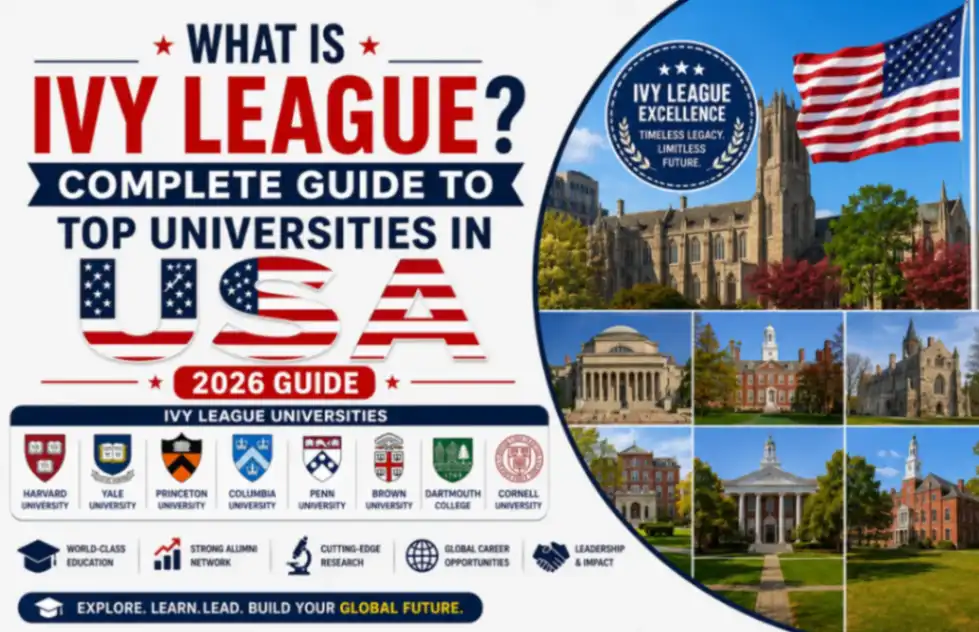
If you are planning to study in the United States, one term you will repeatedly hear is “Ivy League.” For many students in India, Ivy League universities represent prestige, academic excellence, and global career opportunities.
However, a common misconception exists: many students believe Ivy League simply means the top universities in America. In reality, Ivy League refers to a specific group of universities with historical, academic, and athletic significance.
Understanding what Ivy League truly means—and how these institutions compare with other top US universities—is essential before making study abroad decisions through platforms like Infichoice.
The Ivy League is a group of eight private universities located in the northeastern United States. Originally, the term referred to an athletic conference formed in 1954, but over time it became associated with academic prestige and elite education standards.
| University | Location | Founded |
|---|---|---|
| Harvard University | Massachusetts | 1636 |
| Yale University | Connecticut | 1701 |
| Princeton University | New Jersey | 1746 |
| Columbia University | New York | 1754 |
| University of Pennsylvania | Pennsylvania | 1740 |
| Brown University | Rhode Island | 1764 |
| Dartmouth College | New Hampshire | 1769 |
| Cornell University | New York | 1865 |
These universities are among the oldest higher education institutions in the United States.
The reputation of Ivy League schools comes from multiple factors combined over centuries.
Ivy League institutions maintain extremely competitive admissions processes. Acceptance rates typically fall between 3% and 8%, meaning only a small percentage of applicants receive admission offers.
Selective admission helps maintain strong academic environments filled with highly motivated students.
Ivy League universities are major contributors to global research output. Their faculty and researchers produce influential academic publications across fields such as medicine, artificial intelligence, economics, political science, and climate science.
Many discoveries shaping modern society have emerged from these campuses.
Ivy League graduates include:
Nobel Prize winners CEOs of global companies World leaders and policymakers Tech entrepreneurs Renowned scientists and authors
For example, alumni include figures like former US presidents, founders of major technology companies, and influential economists.
The alumni network itself becomes a powerful career advantage.
An important fact many students overlook is that Ivy League does NOT automatically mean the best university for every field.
Several non-Ivy universities rank equally or even higher in specific disciplines.
| Feature | Ivy League Universities | Other Top US Universities |
|---|---|---|
| Institutional Type | Private | Public & Private |
| Admission Selectivity | Extremely High | High to Moderate |
| Research Funding | Very High | Very High |
| Global Reputation | Elite Brand | Field-Specific Excellence |
| Tuition Cost | Higher | Often Lower (Public Universities) |
| Class Size | Smaller | Larger (especially public universities) |
Top institutions like technology-focused universities or public research universities compete strongly with Ivy League schools.
Public universities in the United States are funded partly by state governments and often enroll larger student populations.
Examples include leading state universities known for engineering, technology, and applied sciences.
| Aspect | Ivy League | Public Universities |
|---|---|---|
| Tuition Fees | Higher | Lower for residents |
| Campus Size | Medium | Large |
| Research Opportunities | Extensive | Extensive |
| Diversity of Programs | High | Very High |
| Industry Collaboration | Strong | Often Stronger in STEM |
For Indian students, public universities sometimes offer better return on investment depending on career goals.
Most Ivy League schools follow a liberal arts education model, encouraging students to explore multiple disciplines before specializing.
Students may combine majors such as:
Computer Science + Economics Biology + Public Policy Mathematics + Philosophy
This interdisciplinary approach develops critical thinking and problem-solving abilities.
Ivy League universities emphasize student-faculty interaction. Smaller class sizes often allow students direct access to professors who are leaders in their fields.
This mentorship culture supports research participation even at the undergraduate level.
Research productivity is one of the strongest differentiators of elite universities.
Ivy League institutions consistently produce:
High-impact academic journals Patents and innovation startups Government-funded research projects International collaborations
Students gain opportunities to work as research assistants, strengthening graduate school or industry applications.
Although all fields are strong, some disciplines attract exceptional recognition.
| University | Popular Programs |
|---|---|
| Harvard | Business, Law, Medicine, Public Policy |
| MIT-level competitors (Non-Ivy example) | Engineering & AI |
| Princeton | Mathematics, Physics, Economics |
| Columbia | Journalism, International Relations |
| UPenn | Business (Wharton School) |
| Cornell | Engineering, Hospitality Management |
| Yale | Law, Political Science, Humanities |
Choosing a university based on program strength is often smarter than choosing solely based on Ivy League branding.
Another important clarification: Ivy League membership is not a ranking system.
Global rankings consider factors like:
Research citations Faculty achievements Industry reputation Graduate employability International collaboration
Some non-Ivy universities frequently rank among the world’s top institutions alongside Ivy League schools.
Admission expectations differ significantly.
Excellent academic scores Strong extracurricular achievements Leadership experience Research or project work Personal essays and recommendations Standardized tests (where required)
Admissions evaluate the whole personality, not just marks.
Many strong universities focus more on:
Academic performance English proficiency scores Relevant coursework background
This makes them accessible while still offering excellent education quality.
| Category | Ivy League | Other US Universities |
|---|---|---|
| Tuition Per Year | $55,000–$70,000 | $25,000–$50,000 |
| Scholarships | Need-based aid common | Merit & program scholarships |
| ROI | Strong network benefits | Strong industry placements |
Interestingly, several Ivy League institutions provide generous financial aid packages that reduce actual student costs.
Not necessarily.
The best university depends on:
Career goals Preferred major Budget Learning style Research interests Internship opportunities
For example:
Technology careers may benefit from strong engineering-focused universities. Business careers may depend more on internships and networking exposure.
Success depends more on student effort and opportunities used than university brand alone.
Choosing between Ivy League and other universities can be overwhelming. Infichoice simplifies the decision-making process by offering:
University comparison tools Course-specific guidance Mentor booking for admission strategy Accommodation discovery Online preparation courses Student marketplace networking
Instead of choosing blindly based on reputation, students can make data-driven decisions aligned with career outcomes.
You can compare Universities with academic, admission, tuition and fees, rankings here at Compare Universities
Many misconceptions influence student decisions.
Myth 1: Only Ivy League guarantees success
Reality: Many successful professionals graduate from non-Ivy universities.
Myth 2: Ivy League is only for genius students
Reality: Holistic admissions evaluate personality, leadership, and impact.
Myth 3: Ivy League degrees automatically lead to jobs
Reality: Skills, internships, and networking remain crucial.
Ivy League universities represent academic heritage, research excellence, and global prestige. However, the American higher education system offers hundreds of outstanding institutions capable of delivering world-class education.
For Indian students planning international education, the smartest approach is not chasing labels but selecting universities that align with personal goals, financial planning, and career aspirations.
With structured platforms like Infichoice, students can compare universities objectively, understand academic systems clearly, and confidently choose institutions that support long-term success.
In 2026, informed decisions—not brand names alone—define successful study abroad journeys.

Understanding the US Education System for International StudentsOne of the biggest confusions Indian...

Studying abroad begins long before stepping onto an international campus. The most successful inte...


Germany is one of the best countries to study Mechanical Engineering. It is famous for its strong in...

Studying abroad is a dream for many Indian students, but high tuition fees often make it seem diffic...